Template Class EvalKeyImpl
Defined in File evalkey.h
Page Contents
Inheritance Relationships
Base Type
public lbcrypto::Key< Element >(Template Class Key)
Derived Type
public lbcrypto::EvalKeyRelinImpl< Element >(Template Class EvalKeyRelinImpl)
Template Parameter Order
class Element
Class Documentation
-
template<class Element>
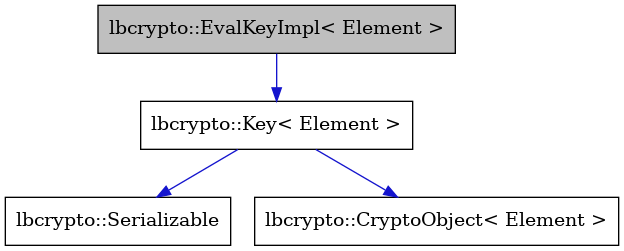
class lbcrypto::EvalKeyImpl : public lbcrypto::Key<Element> Inheritence diagram for lbcrypto::EvalKeyImpl:

Collaboration diagram for lbcrypto::EvalKeyImpl:
Abstract interface for evaluation/proxy keys.
- Template Parameters
Element – a ring element.
Subclassed by lbcrypto::EvalKeyRelinImpl< Element >
Public Functions
-
EvalKeyImpl() = default
Default constructor
-
inline explicit EvalKeyImpl(const CryptoContext<Element> &cc)
Constructs an evaluation key in the given crypto context with an empty key tag.
- Parameters
cc – the crypto context the key belongs to
-
EvalKeyImpl(const EvalKeyImpl&) = default
-
EvalKeyImpl(EvalKeyImpl&&) noexcept = default
-
virtual ~EvalKeyImpl() = default
-
EvalKeyImpl &operator=(const EvalKeyImpl&) = default
-
EvalKeyImpl &operator=(EvalKeyImpl&&) noexcept = default
-
inline virtual void SetAVector(const std::vector<Element> &a)
Setter function to store Relinearization Element Vector A. Throws exception, to be overridden by derived class.
- Parameters
a – is the Element vector to be copied.
-
inline virtual void SetAVector(std::vector<Element> &&a)
Setter function to store Relinearization Element Vector A. Throws exception, to be overridden by derived class.
- Parameters
a – is the Element vector to be moved.
-
inline virtual const std::vector<Element> &GetAVector() const
Getter function to access Relinearization Element Vector A. Throws exception, to be overridden by derived class.
- Returns
Element vector A.
-
inline virtual void SetBVector(const std::vector<Element> &b)
Setter function to store Relinearization Element Vector B. Throws exception, to be overridden by derived class.
- Parameters
b – is the Element vector to be copied.
-
inline virtual void SetBVector(std::vector<Element> &&b)
Setter function to store Relinearization Element Vector B. Throws exception, to be overridden by derived class.
- Parameters
b – is the Element vector to be moved.
-
inline virtual const std::vector<Element> &GetBVector() const
Getter function to access Relinearization Element Vector B. Throws exception, to be overridden by derived class.
- Returns
Element vector B.
-
inline virtual void ClearKeys()
Releases the key material held by the evaluation key. Throws exception, to be overridden by derived class.
-
inline virtual bool key_compare(const EvalKeyImpl &other) const
Compares this key with another evaluation key. The base implementation always reports inequality; derived classes override it.
- Parameters
other – the evaluation key to compare with
- Returns
true if the keys are equal
-
inline virtual std::string SerializedObjectName() const override
Returns the name identifying the derived class in serialized form; every serializable class provides it.
- Returns
the serialized object name
Friends
-
inline friend bool operator==(const EvalKeyImpl &a, const EvalKeyImpl &b)
Equality of evaluation keys, delegated to the virtual key_compare() of the left operand.
- Parameters
a – left operand
b – right operand
- Returns
true if a.key_compare(b) reports equality
-
inline friend bool operator!=(const EvalKeyImpl &a, EvalKeyImpl &b)
Inequality of evaluation keys: negation of operator==.
- Parameters
a – left operand
b – right operand
- Returns
true if the keys differ